

He’s nineteen years old, somewhere in the Pacific Ocean, on night watch aboard a nuclear-powered ship.
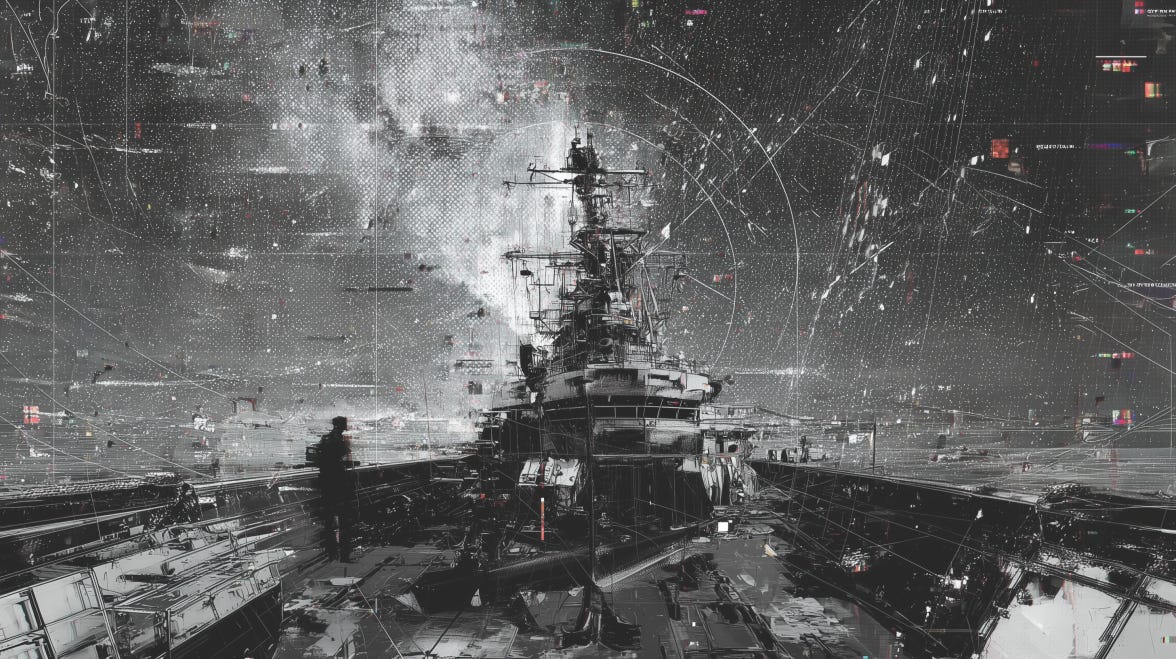
The ocean goes pitch black at night. No ambient glow, no city edge on the horizon. Just the water and whatever’s above it. And when there’s nothing competing, the stars come in hard. Brighter than you’ve ever seen them. Exactly like the movies. You didn’t think it would actually look like that.
Tyler Temple looked up and felt something lock in.
That image is where Pollentia starts. Not in a pitch deck, not at a hackathon. On a Navy vessel, in the dark, with a sky that finally showed itself.
Tyler Temple, CEO of Pollentia, founded the company at nineteen, in 2021, while still processing that experience. The original idea was an electric boat. The instinct was right, but the form was early. By late 2025, after Capital Factory pulled him into rooms full of defense technologists, commercial operators, and prospective boaters all saying the same thing, the form clarified: it wasn’t the boat they wanted. It was the brain inside it.
Pollentia pivoted to tech-first. The vessel became the platform.
Most people, when they hear “AI for boats,” reach for the autopilot comparison. Tyler hears it constantly, and so I asked him why it’s wrong.
“An autopilot typically means self-driving, or assistance in driving. That’s not what Pollentia is in its current state.”
What Pollentia is: preventative maintenance, damage diagnostics, sensor fusion, cybersecurity, global network connectivity. A system that monitors the health and state of the vessel continuously, absorbs data from whatever hardware is already onboard, and translates that into something the operator can actually use. It’s an infrastructural amendment, not a replacement for the human at the helm.
The marine tech ecosystem is, by Tyler’s description, deeply fragmented. Radar from one vendor, sonar from another, navigation systems that don’t talk to each other. Most MFDs (multifunction displays, the primary control interface on most vessels) are effectively closed. Proprietary. Each manufacturer is guarding its slice of the stack.
Pollentia’s posture is to absorb all of it.
“There is a better way for these kind of systems to play more as an orchestra than solo quartets.”
He reaches for that image unprompted. Orchestration, not replacement. The existing instruments stay. Pollentia becomes the conductor: pulling signal from each, translating it into coherent system state, feeding it back to the operator as something legible. The goal isn’t to own the stack. It’s to make the stack finally behave like one.
// fractured stack detected
// conductor layer initializing
I’ve spent time on the UX side of a similar problem. At OCTO, I directed interface work on Havoc, an autonomy platform that has since expanded into all-domain operations. Havoc recently closed a $100M Series A. This is no longer speculative terrain. It is an industry hardening around a question: how do humans command systems too complex to perceive directly?
Here’s where it gets interesting for me as a designer, and as someone who writes about the entanglement between humans and their systems.
Tyler didn’t use the word cyborg. He didn’t need to.
“If it has physical and digital controls over your vessel, and you’ve given this boat practically a nervous system, you should be able to have that data and retain it within the system.”
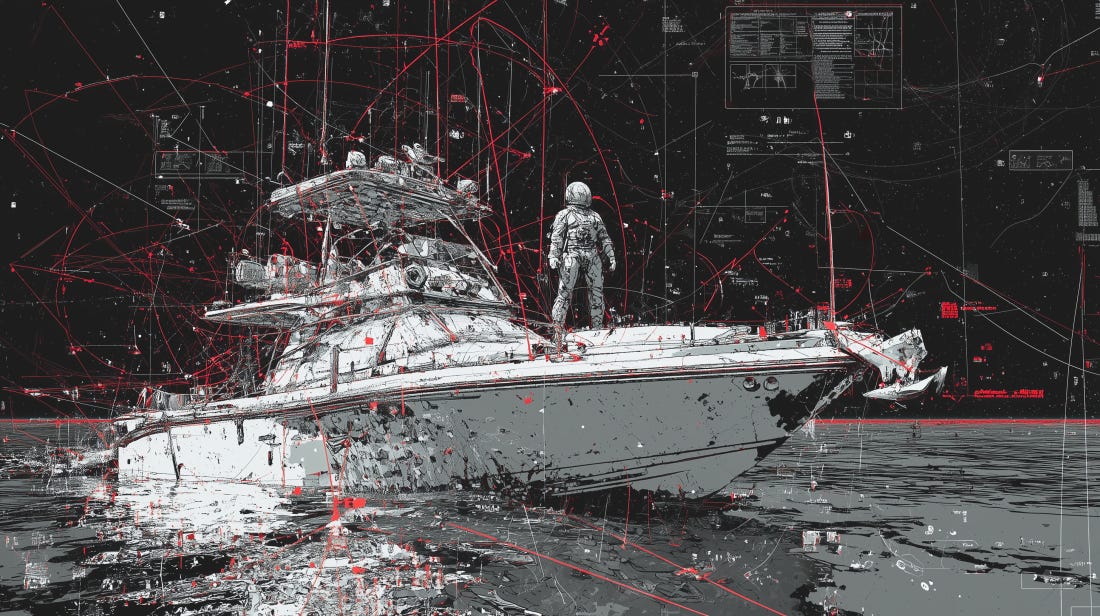
A nervous system. The vessel stops being a machine you operate and starts being a system you’re coupled to. Sensors feeding state back through the platform, the platform adjusting, the operator reading the output and making decisions, those decisions feeding back into the system. Wiener1 would recognize it immediately. That’s a feedback loop. Cybernetics.
// cybernetics enters without being namedThe operator relationship Tyler describes goes further.
“It’s playing like a digital twin of yourself. Your digital one is so advanced, it’s what you kind of aspire to be.”
That is the strange part. The system is not merely helping you operate the vessel. It is modeling a more capable version of you back to yourself.
That’s not a tool. That’s an extension. A version of you that already knows the water, already has the protocols, already factored in the eruption off the coastline and calculated the route back to shore. You, but with the latency removed. You, augmented.
// operator and system: no longer separate processesThis is the cyborg condition applied to maritime autonomy. Not a robot boat. Not autopilot. A human operator, coupled to a platform that extends their perception and cognition across the full state of the vessel and its environment. The human stays in the loop. The loop gets much bigger.
What Tyler is building is, in the most precise sense, a prosthetic for situational awareness. Not one that disappears, but one that knows when to speak.
The pivot took longer than the pitch version makes it sound.
Tyler founded Pollentia in 2021, at nineteen, while still processing his time in service. The original vision was an electric boat, renewable energy applied to maritime. He kept it quiet for three years. No press, no public presence. Just building, learning how to run a company, finding the right team.
They came out in 2024. Then Capital Factory pulled them into a wider orbit, and something shifted. Outside the marine industry, the signal was consistent: people weren’t excited about the boat. They were excited about what was running inside it.
“We were getting a lot of traction for the tech. People were saying, the boat’s nice, but the tech is amazing.”
One person saying that is noise. A roomful of defense technologists, commercial operators, and prospective boaters all saying it, with specific reasons and a clear pathway, is a pivot. October 2025, Pollentia went tech-first. By March 2026 they were at SXSW with a product name: AI Co-Captain. A few weeks after that, Tyler was pitching in front of Tim Draper at Draper University. Same thesis, fast room, no time to overthink.
“If you are juggling and creating your own Frankenstein, I don’t think that should continue.”
Commercial first, with early test beds and deployments in recreational craft. Defense and government the eventual push. Patient, then fast.
Something I’ve started asking every builder I talk to: what sci-fi shaped you, and does it show up in what you’re building?
Tyler answered without a beat. Interstellar, Iron Man, Passengers. Movies that took seriously the question of what humans might do with the right systems around them. And then, unprompted: “How are you able to take things that were seen in sci-fi films and apply them to realism, here in the maritime industry?”
He didn’t need to think about it. The answer was already the product.
Then the Navy. The Pacific Ocean at night. Stars so bright they looked exactly like the movies. And a decision, somewhere in that darkness, to build something with the weight of meaning behind it.
“Pollentia is Latin for mighty and powerful. I wanted to do something that had deeper meaning.”
The stars. The ancient name. The orchestra that finally plays together. A vessel that knows itself. A captain extended into the system around them.
// vessel and operator: one feedback loop
// the ocean doesn’t care about your fragmented stack
Pollentia is early. The platform is still evolving. The market is still phasing up. But the thesis has been consistent in every room he walks into.
He’s building the nervous system first. Everything else follows.
To follow along with Pollentia’s development, head to https://www.pollentiainc.com/
Norbert Wiener (1894–1964) was an American mathematician and the founder of cybernetics, the study of regulatory systems, feedback loops, and control mechanisms in both machines and living organisms. His 1948 book Cybernetics: Or Control and Communication in the Animal and the Machine established the conceptual framework that Signal+Static draws on when describing organizations, operators, and human-machine systems as feedback-driven rather than linear.
Can't wait to learn more.....makes so much sense. As usual, your writing style is so uniquely yours, Marcel!