

// BOOT
There was a felt shift in tone, posture, and the collective nervous system at DDX San Diego.
Just a matter of months after DDX NYC (which I write about here) I sensed a more tuned and cohesive perspective about AI in the field of user experience and digital design. People were less spooked, moving toward preparation and analysis. Positioning instead of posture.
// sys.log

calibrating… detect shift in crowd affect. fear subsiding. designers thawing from freeze state. posture → position.
Design is moving from screens to systems. From apps to agents. Using relationships as control loops.
San Diego felt like design stepping out of the screen and into the system: agents, rituals, city sidewalks, and the quiet OS of brand. If NYC was “scaffolding the system,” San Diego was “tuning the instruments.” Below are the clearest tones I heard across frequencies, re-transmitted through the cyborg lens.
// Sebastian Gier — Opening Pulse
The signal I captured from Sebastian was this: design is a privilege that materializes futures. (The line “Design is a privilege” is attributed to ex-frog design authority Robert Fabricant.)
Layer that with a data point—“10% of countries account for 80% of global R&D spending”—and you get a clear call to rethink participation and expand who gets to design the future.
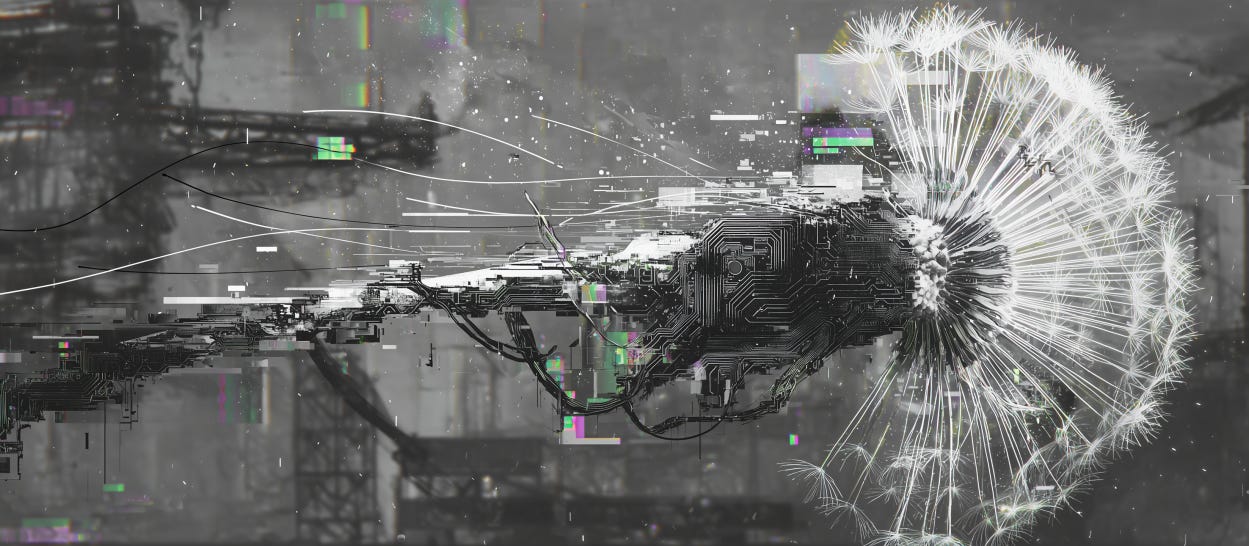
“Grow like a dandelion, not a leviathan. Network, don’t centralize.”
As a growth strategy it’s resilient and radically inclusive. But growth needs direction: grow the network into under-represented populations when you can.
// subsystem.attitude
distributed agency > concentrated control
resilience emerges through replication
networks survive what empires cannot
Cyborg lens: distributed agency is resilience. Replication beats sheer mass. Every good cyborg knows.
// Don Norman — Better Together: Why Partnerships Matter
If you’re not familiar with Don Norman, do your homework. He helped shape the field of UX; his Design of Everyday Things taught many of us to notice the design of everyday life.
At DDX he and Sebastian Gier shared a casual, useful fireside chat. The through-lines follow.
Move from human-centered to humanity-centered. This flips the paradigm and echoes Gier’s call for inclusion. Community-first methods beat parachute expertise.
Share struggles, not just wins. It teaches better, signals pyschological safety and invites others into a culture of candor.
Become organizationally fluent. Speak ops and finance. Show the spreadsheet—or at least how your work fits it. If you can’t plug into the org’s logic, you can’t defend the work (or grow the team).
For the AI age, Norman offered a concise reframe:
“You’re not looking for a website; you’re looking for an answer.”
Patterns are leaning harder into answers over paths. That’s an interaction contract shift.
// sys.notice
input modality changed: search → synthesis → answer.
the interface dissolves. intent remains.
Cyborg lens: questions, not clicks, are the new primary input. Design for answers (and for how answers are made).
// Scott Robinson — Now / Near / Next (2025)
Scott’s talk made my cyberdeck flutter. I’ve advocated for wet and squishy UI for awhile. Black mirrors are boring. Scott’s vector matched the mood: move beyond glass.
Voice. Gesture. Gaze. He pointed toward design that spans HCI into something closer to HCR (human–computer–robotics)—and MMI (machine–machine interaction) as agents begin talking to agents without us.
He also called to swap the linear “script” for the infinite loop. Readers here will recognize that terrain: we are in and of the cybernetic loop.
// subsystem.loop
linear → cyclical
static → adaptive
screen → space
user → participant
We’ll need new rituals and roles. One provocation Robinson dropped was AIR—AI Resources—like HR, but for agents and their conduct. While this may feel speculative, it isn’t. It’s the practical UX work emerging right now.
He then offered three fronts of fertile fieldwork: civic infrastructure (sidewalk etiquette for robots), health autonomy (a calmer, evidence-tuned way to inform choices), and education for all (personalized tutors—obligatory nod to Stephenson’s Diamond Age).
Cyborg lens: UX becomes societal middleware. Norms, not just screens and flows.
// Alex Diener — You Can’t Have Lunch with AI
The title says it all. You can eat lunch with a Chatbot. But that’s not the point.
Work runs on relationships. Mentorship and cross-discipline trust are forged through durable, embodied contact. Post-pandemic, many of our rituals atrophied. We have to rebuild them deliberately.
In a post-Covid world, we work against headwinds: time starvation, siloization, and remote drift. How do we counter that? Diener says: be intentional.
To press against the headwinds, Alex offered ready-to-action steps.
Perform a relationship audit: Which relationships are working? Which need work? Why?
Set goals: Set some goals for your relationships. Make them stronger, define them better.
Write it down: Don’t let the goal slide or misform in memory.
Go do it (in person): Take a co-worker to lunch. Take a finance guy on an inspiring trip to a museum, or the ops lead to see a performance.
Be the native face of design: Don’t be passive or pushy. Just be your natural, designer self.
None of this can be outsourced or automated away.
// sys.human_only
relationship bandwidth cannot be virtualized.
embodiment required.
latency = emotional, not network.
Cyborg lens: social firmware is still human-only.
// Gleb Kuznetsov — What Happens to Design When Every Pixel Can Think?
We’re moving from app-centric to agentic. Generative interfaces will form around goals instead of force-marching users through deterministic flows.
“People now ask, not tap.”
Kuznetsov offered a clean division of labor. AI brings speed, scale, automation, consistency. Humans bring empathy, imagination, taste, strategy
He also named the fork that matters for how we relate to AI: Anthropomorphic agents (Jarvis-esque emotional stand-ins) and Extension-of-mind tools (the cyborg path).
// subsystem.recommendation
choose extension-of-mind
synthetic intimacy is a distraction
cognitive augmentation is the upgrade
anything else is cosplay
Whichever path you take, the cyborg is the point. Augment cognition; don’t chase replicas of “human.”
// Leadership Panel — (Paul Lafata · Alex Diener · Madison Stevens; mod: Sebastian Gier)
Panels can be tough; this one was fruitful. Bottom line up front: measure yourself by others’ growth. The panel snapped the discussion back to earth. They guided the conversation away from agents and pixels, toward people and the messy reality of leading them.
Emergent guiding principles:
Culture breathes. Make expectations explicit. Designers act as brokers as AI redraws role lines. And above all: protect entry-level pathways. Preserve manual synthesis, lived depth, and awkward, necessary early-career practice.
In response to an audience question, these leaders also offered some clear hiring signals. If you’re in the market for an entry into your design career, or to grow your current position, cultivate these traits: curiosity, decision frameworks, comfort with ambiguity, hunger for the hardest problems.
// sys.org
culture = living organism
leadership = metabolic process
design teams = distributed nervous systems
Cyborg lens: steward the human network that stewards the machine network.
// OUT
If NYC was about scaffolding, San Diego pushed us toward agents and cultureware—brand kernels, human rituals, and systems that touch the street.
I’ll publish a deeper paid debrief next (including an NYC→SD shift analysis and per-talk artifacts). Stay tuned and upgrade if want the deeper circuitry.
For now: which ritual will you adopt this week: draft a prompt library, a trust checklist, or simply lunch?
If you attended DDX, or just want to chat about anything here, please reach out; let’s grow the network like a dandelion.
You might like these transmissions
DDX NYC: Systems, Signals & Scaffolding
A field report on the earlier phase of AI-era UX. It pairs well with the San Diego post because you can trace the shift from fear and structure-building to confidence, agency and system fluency.
The Cyborgs Aren’t Coming
A grounding signal on our everyday entanglement with tools and invisible systems. Read this next if you want a primer on the cyborg lens that underpins the entire DDX San Diego recap.
Pilot Mode
A dive into designing trust, fluency and embodied cognition inside a next-generation cockpit. This connects cleanly to the agentic and beyond-the-screen conversations that surfaced in San Diego.
If this signal resonates, amplifying it helps the network grow with intention. Share Signal+Static with a friend or colleague and help us grow like a dandelion.